Foto Copyright: Bertram Boelkow, Lancaster University Leipzig
Pro-Vice-Chancellor,
Madam Mayor,
Ladies and Gentlemen,
When I was at school in Bavaria many years ago, we had an English teacher who had recently fled from East to West Germany, which must have taken enormous courage to do in the 1960s, but which we as schoolboys hardly appreciated. She had never been to the UK, and her knowledge of English was purely academic. We quarelled incessantly, she maintaining that my knowledge of English grammar was non-existent, which was true, while I made it very clear to her what I thought of her English accent. Obviously her position was stronger than mine, so I landed up with rather bad marks. My English mother who brought us up on the principle that „British is best“ was horrified, so perhaps it’s that little chip on my shoulder that made me volunteer for the German British Society – or Deutsch-Britische Gesellschaft in German – where I was eventually elected to the board, and that is why I have the honour to address you today. And a special honour to be invited to speak in this church, where German history was enacted at one of its crucial moments.
Luckily, times have changed. Germany, as you know, was reunited over 35 years ago, and I don’t think an English teacher whose English is not up to standard would be tolerated at any school in Germany today. Here in Saxony, incidentally, the first Minister of Culture and Education after reunification, Hans Joachim Meyer, was an East German English scholar who spoke excellent English, so it’s perhaps not entirely accidental that Lancaster University chose Leipzig for its German campus, Leipzig of course also having been one of the most important trade centres in Central Europe for centuries.
As of course you also realize, official relations between the United Kingdom and Germany are entering into a radically new phase. In Britain, Brexit is now increasingly being seen as a mistake, as it always has been in Germany, and you will have heard that Prime Minister Andy Burnham, who made his first overseas bilateral visit to Berlin a couple of weeks ago, recently floated the idea of rejoining the European Union as a serious policy option. Perhaps even more importantly – and indeed crucially – Britain and Germany plus a few other „middle powers“, as Canada’s Mark Carney has aptly described us, are cooperating on defense and security as well as foreign policy issues more closely than we have done for quite a while. E3 (UK, France, and Germany), now equipped with a permanent secretariate, and E5 (the three plus Poland and Italy), are in place and other cooperative arrangements are mushrooming. Bilateral agreements between the UK and Germany, most prominently the Kensington Treaty, have been duly signed and ratified. Those of us who are keen on looking ahead and hoping for an ever closer relationship, are waiting to see what will happen next. Our hopes are high.
But Anglo-German partnership is not just about governments. The German-British Society was founded in Düsseldorf in 1949 by spirited citizens, Lilo Milchsack and 6 of her friends. She was convinced then that a fresh start was of essence and that this should not be left to governments alone. As German-British Society, we believe as strongly as the founders did then in moving issues by convening. Whether we are on the up, as we are at the moment, or on the down, as we certainly have been occasionally, we always recognized the need to meet, to listen, to learn, and to make proposals, in short not to leave it all to the politicians and civil servants. Academics in both countries, including a fair number of expats, have contributed substantially to keeping the ‚people to people‘ dialogue going, even in times when the two governments did not produce very much in the way of even having a conversation.
Copyright: Bertram Boelkow, Lancaster University Leipzig
We organized the first bilateral conference in Koenigswinter on the Rhine in 1950. The 76th Koenigswinter conference was held in Manchester in 2026, and the next one will be in Hamburg in 2027. The name Koenigswinter has stuck, while the venues and the format have changed, and we now also hold Defense, Economic and Young Koenigswinter conferences in addition to the main event. Young Koenigswinter in particular is a success story, as it brings together young leaders aged 25 – 30. Young Koenigswinter Alumni, who by the way have their own association, can now be traced in a plethora of top jobs in both countries. You – to mean the students present here – are most welcome to apply for a place at a future Young Koenigswinter Conference, but I do have to tell you that competition is stiff.
In my day work, I am with a think tank that focusses on civil society and civic engagement, on what are now termed non-state actors in international politics. We try to create awareness for many other civil society organisations that exercise what an American political scientist, Joseph Nye, has called soft power. My research and my work underpin my conviction that in the public sphere of a modern and open society, state and non-state actors, governments, the private sector, civil society, academia, and indeed individual citizens all have decisive roles to play. In saying this, I follow Ralf Dahrendorf, a German academic cum politician, who ended up as head of the London School of Economics and subsequently of St. Antony’s College at Oxford, and a Peer of the Realm, who incidentally impressed this train of thought on many a Koenigswinter Conference. As young academics, you are invited and indeed should be encouraged to follow this up.
Let me end as I began on a personal note. My master thesis at university a long time ago was on the Levellers, a 17th century protest movement, universally known in England, but hardly in Germany, although quite important, as in the history of ideas one can draw a line from their pamphlets in the 1630s and ’40s to those published in the run-up to the American Declaration of Independence in 1776. The Levellers remind us that contrary to what history books and media try to hammer into us, history is not written exclusively by kings, politicians, or political parties. The citizens of Leipzig provided ample proof of this in 1989. They were the first to organize popular protest in what was then the German Democratic Republic. Through their Monday rallyes (Montags-demonstrationen), the first of which was on 4th September, 1989, they wrote history. More and more people took to the streets every Monday and in more and more places in East Germany, and just over two months later, as we all remember, the Berlin wall collapsed.
Taking to the streets is of course not called for at every moment in history, so my advice is not necessarily to follow up on what we saw in Germany last week-end, but I would want to encourage you to become active and engaged citizens and hopefully, if your experiences in Leipzig are not too devastating, to help us preserve an open and free society in Germany, in the UK and everywhere in the world.
Kommentare werden geladen …
Sie sehen gerade einen Platzhalterinhalt von reCAPTCHA. Um auf den eigentlichen Inhalt zuzugreifen, klicken Sie auf die Schaltfläche unten. Bitte beachten Sie, dass dabei Daten an Drittanbieter weitergegeben werden.

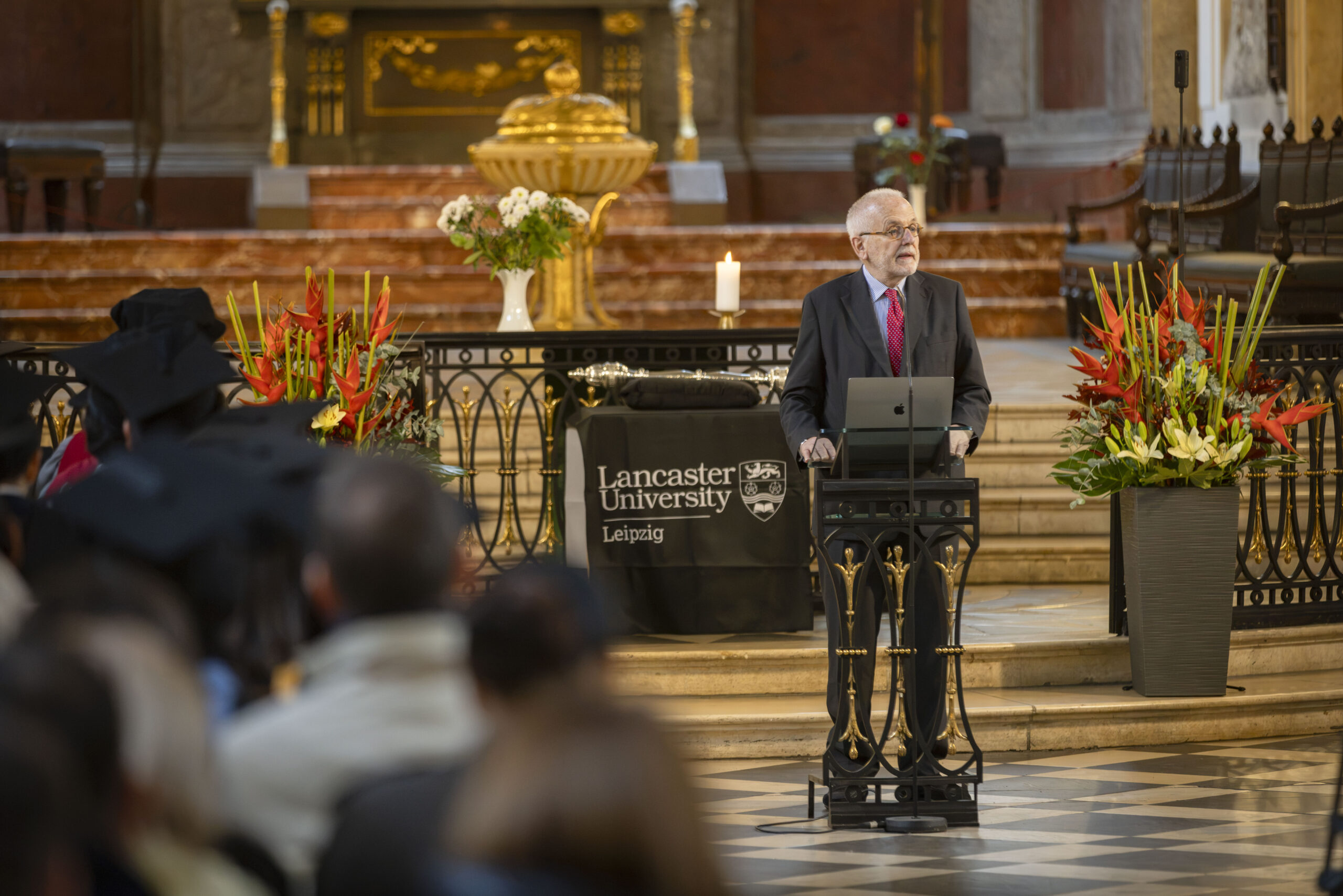
Foto Copyright: Bertram Boelkow, Lancaster University Leipzig
Pro-Vice-Chancellor,
Madam Mayor,
Ladies and Gentlemen,
When I was at school in Bavaria many years ago, we had an English teacher who had recently fled from East to West Germany, which must have taken enormous courage to do in the 1960s, but which we as schoolboys hardly appreciated. She had never been to the UK, and her knowledge of English was purely academic. We quarelled incessantly, she maintaining that my knowledge of English grammar was non-existent, which was true, while I made it very clear to her what I thought of her English accent. Obviously her position was stronger than mine, so I landed up with rather bad marks. My English mother who brought us up on the principle that „British is best“ was horrified, so perhaps it’s that little chip on my shoulder that made me volunteer for the German British Society – or Deutsch-Britische Gesellschaft in German – where I was eventually elected to the board, and that is why I have the honour to address you today. And a special honour to be invited to speak in this church, where German history was enacted at one of its crucial moments.
Luckily, times have changed. Germany, as you know, was reunited over 35 years ago, and I don’t think an English teacher whose English is not up to standard would be tolerated at any school in Germany today. Here in Saxony, incidentally, the first Minister of Culture and Education after reunification, Hans Joachim Meyer, was an East German English scholar who spoke excellent English, so it’s perhaps not entirely accidental that Lancaster University chose Leipzig for its German campus, Leipzig of course also having been one of the most important trade centres in Central Europe for centuries.
As of course you also realize, official relations between the United Kingdom and Germany are entering into a radically new phase. In Britain, Brexit is now increasingly being seen as a mistake, as it always has been in Germany, and you will have heard that Prime Minister Andy Burnham, who made his first overseas bilateral visit to Berlin a couple of weeks ago, recently floated the idea of rejoining the European Union as a serious policy option. Perhaps even more importantly – and indeed crucially – Britain and Germany plus a few other „middle powers“, as Canada’s Mark Carney has aptly described us, are cooperating on defense and security as well as foreign policy issues more closely than we have done for quite a while. E3 (UK, France, and Germany), now equipped with a permanent secretariate, and E5 (the three plus Poland and Italy), are in place and other cooperative arrangements are mushrooming. Bilateral agreements between the UK and Germany, most prominently the Kensington Treaty, have been duly signed and ratified. Those of us who are keen on looking ahead and hoping for an ever closer relationship, are waiting to see what will happen next. Our hopes are high.
But Anglo-German partnership is not just about governments. The German-British Society was founded in Düsseldorf in 1949 by spirited citizens, Lilo Milchsack and 6 of her friends. She was convinced then that a fresh start was of essence and that this should not be left to governments alone. As German-British Society, we believe as strongly as the founders did then in moving issues by convening. Whether we are on the up, as we are at the moment, or on the down, as we certainly have been occasionally, we always recognized the need to meet, to listen, to learn, and to make proposals, in short not to leave it all to the politicians and civil servants. Academics in both countries, including a fair number of expats, have contributed substantially to keeping the ‚people to people‘ dialogue going, even in times when the two governments did not produce very much in the way of even having a conversation.
We organized the first bilateral conference in Koenigswinter on the Rhine in 1950. The 76th Koenigswinter conference was held in Manchester in 2026, and the next one will be in Hamburg in 2027. The name Koenigswinter has stuck, while the venues and the format have changed, and we now also hold Defense, Economic and Young Koenigswinter conferences in addition to the main event. Young Koenigswinter in particular is a success story, as it brings together young leaders aged 25 – 30. Young Koenigswinter Alumni, who by the way have their own association, can now be traced in a plethora of top jobs in both countries. You – to mean the students present here – are most welcome to apply for a place at a future Young Koenigswinter Conference, but I do have to tell you that competition is stiff.
In my day work, I am with a think tank that focusses on civil society and civic engagement, on what are now termed non-state actors in international politics. We try to create awareness for many other civil society organisations that exercise what an American political scientist, Joseph Nye, has called soft power. My research and my work underpin my conviction that in the public sphere of a modern and open society, state and non-state actors, governments, the private sector, civil society, academia, and indeed individual citizens all have decisive roles to play. In saying this, I follow Ralf Dahrendorf, a German academic cum politician, who ended up as head of the London School of Economics and subsequently of St. Antony’s College at Oxford, and a Peer of the Realm, who incidentally impressed this train of thought on many a Koenigswinter Conference. As young academics, you are invited and indeed should be encouraged to follow this up.
Let me end as I began on a personal note. My master thesis at university a long time ago was on the Levellers, a 17th century protest movement, universally known in England, but hardly in Germany, although quite important, as in the history of ideas one can draw a line from their pamphlets in the 1630s and ’40s to those published in the run-up to the American Declaration of Independence in 1776. The Levellers remind us that contrary to what history books and media try to hammer into us, history is not written exclusively by kings, politicians, or political parties. The citizens of Leipzig provided ample proof of this in 1989. They were the first to organize popular protest in what was then the German Democratic Republic. Through their Monday rallyes (Montags-demonstrationen), the first of which was on 4th September, 1989, they wrote history. More and more people took to the streets every Monday and in more and more places in East Germany, and just over two months later, as we all remember, the Berlin wall collapsed.
Taking to the streets is of course not called for at every moment in history, so my advice is not necessarily to follow up on what we saw in Germany last week-end, but I would want to encourage you to become active and engaged citizens and hopefully, if your experiences in Leipzig are not too devastating, to help us preserve an open and free society in Germany, in the UK and everywhere in the world.